
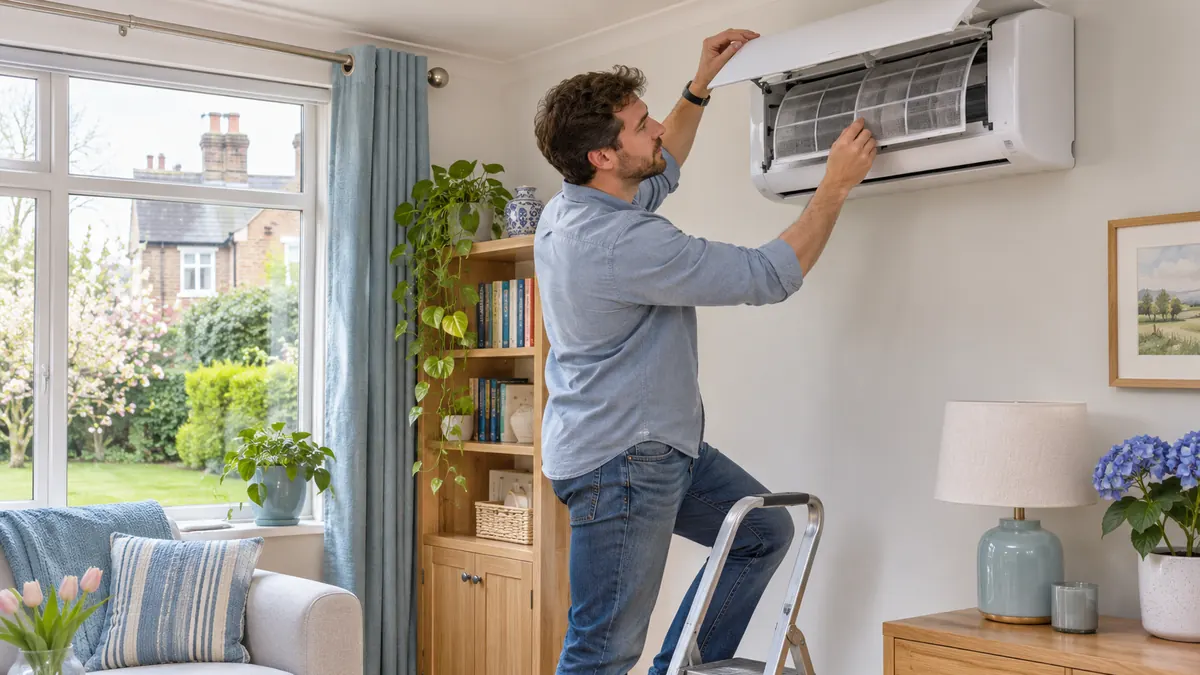
Before the first hot day, give your air conditioner a short check. Clear anything blocking airflow, inspect the parts your manual lets you reach, and run a cooling test while you still have time to arrange a repair. This is useful whether the system sat idle all winter or spent the colder months heating your home.
You do not need to take a split unit apart. Leave internal cleaning, electrics and refrigerant work to a qualified professional.
What should you check before switching it on?
Find the manual for your exact model. With the system off, look at the accessible indoor filter and clean or replace it if the instructions say it is due. Check that curtains and furniture do not block the inlet or outlet. Look for signs of water staining around a wall-mounted unit, but do not open its casing to investigate.
For a split system, inspect the outdoor unit from a safe position. Remove loose leaves or objects blocking the openings and trim plants that have grown too close. Follow the manufacturer’s clearance instructions rather than a generic distance. Do not remove a grille, spray electrical covers or climb a ladder to clean the unit. Our Air Conditioner Maintenance: What Can You Do Yourself? guide gives the detailed filter and outdoor-unit routine.
If the system has an isolator that was switched off for winter, follow its manual’s start-up instructions. Some models need power restored before operation. If you see damaged wiring, a loose mounting or a tripping circuit, leave the unit off and call an installer or electrician.
What should you check on a portable unit?
Take it out of storage and check for damage to the plug, cable, cabinet and exhaust hose. Fit the hose exactly as the maker directs and check that the window kit closes the gap around it. A poor seal allows warm air back into the room. Make sure neither end of the hose is crushed or blocked.
Clean the accessible filter according to the manual. Check whether the tank needs emptying and how the model handles condensate in cooling mode. If you transported the appliance on its side, follow the maker’s instructions about how long it should stand upright before starting. Do not guess a universal waiting time.
How do you run a first cooling test?
Choose a day when the room is warm enough to test cooling meaningfully. Close the windows, set Cool mode and choose a target a few degrees below the actual room temperature. Give the unit the start-up time specified in its manual; some compressors wait before engaging. Check for normal airflow, a comfortable change in room temperature and any error code.
Listen for rattles or grinding and look for water dripping indoors. For a split system, note whether the outdoor unit starts as expected; it need not run continuously on every model. A remote showing a snowflake or a spinning indoor fan does not prove that the compressor is cooling. If the room remains warm, our Why Is My Air Conditioner Running but Not Cooling? guide gives safe basic checks.
Avoid setting the remote to its lowest temperature as a “test”. That can leave the unit running much longer than needed and tells you little about normal operation. Use the temperature you would choose on a summer day.
What if it smells or leaks?
A little stale dust smell at first start may clear, but a continuing musty smell needs attention. Clean the accessible filter as directed and check the room for other damp sources. If the smell persists, ask a technician to inspect the internal coil, drain and condensate tray. Our Why Does My Air Conditioner Smell Musty When I Turn It On? guide covers the possibilities.
Turn the unit off if water drips from a wall unit, ice forms, an error repeats, a breaker trips or you smell burning. Do not pour bleach or vinegar into a hidden drain, spray cleaner into the casing or repeatedly reset a breaker. Daikin’s UK advice recommends professional attention for persistent odours and performance problems.
When should you book a service?
Check the maker’s service schedule and warranty terms. A split system often has a recommended annual professional service; book ahead of the first heatwave if one is due. Ask the engineer to check operation, airflow, drainage, controls and the condition of accessible electrical parts, with internal cleaning where needed. Refrigerant should not need routine “topping up”; a loss of cooling calls for diagnosis.
Keep a note of the model, any fault code, when the issue began and what you checked. That makes the visit more useful. Work on equipment containing F-gas requires the right qualifications.
How can you prepare for the next summer?
Record when you checked the filter and when the next service is due. If a room overheats every year, shade it before the sun reaches the windows and consider whether the system is the right size. CostToCool’s free Calculate my current setup can estimate cooling costs using your system and schedule; Plan cooling for my home can estimate capacity and costs if you are considering a replacement. Neither tool diagnoses a fault.