
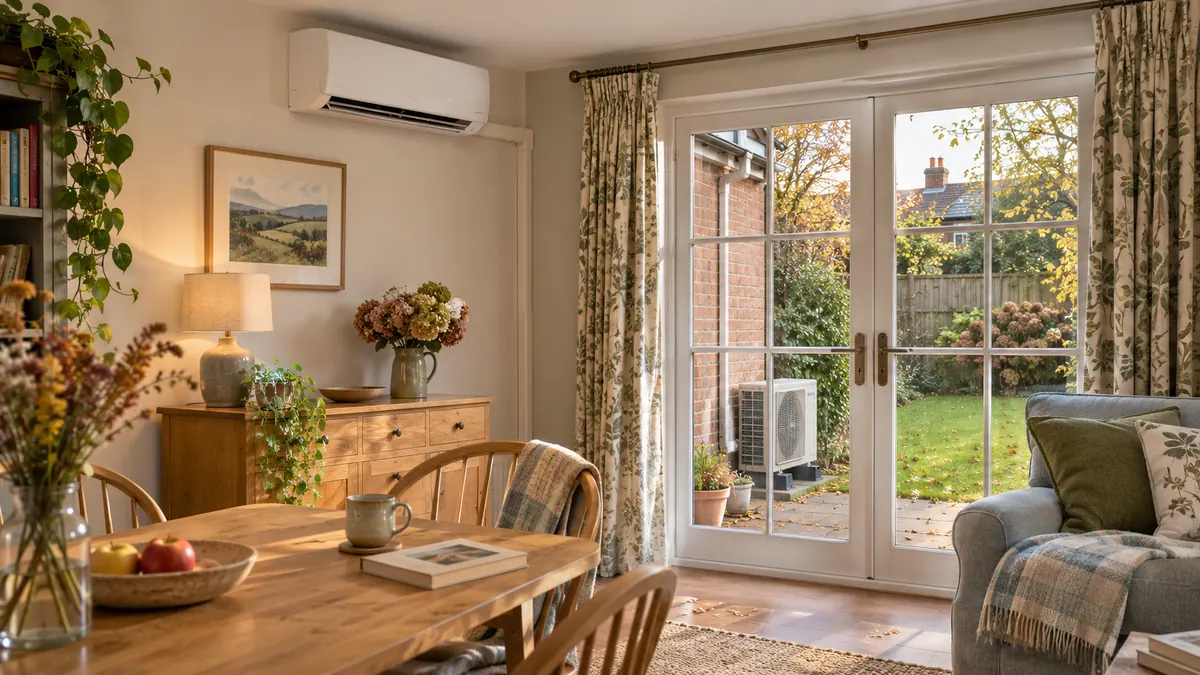
An air-to-air heat pump moves heat between outdoor air and the air inside your home. Many wall-mounted split air conditioners are reversible air-to-air heat pumps: they cool a room in summer and warm it in winter. The same indoor and outdoor units do both jobs.
That does not mean every air conditioner heats. Check the model’s specifications for a heating mode before buying or trying to use one for winter warmth.
What does “air-to-air” mean?
The first “air” is the outdoor source of heat. The second is the indoor air that receives it. In heating mode, the outdoor unit extracts heat from outside air, even when that air feels cold, and the indoor unit blows warmed air into the room. In cooling mode, the process runs the other way: the system takes heat from indoor air and releases it outdoors.
The Energy Saving Trust’s air-to-air guide describes these systems as a way to heat or cool rooms without a wet radiator circuit. Most wall-mounted models recirculate indoor air. You still need a way to ventilate your home; heating or cooling is not the same as bringing in fresh air.
How does it heat and cool?
The system circulates refrigerant between an indoor unit and an outdoor unit. A compressor and two heat exchangers help it collect heat in one place and release it in another. A reversing valve changes which direction the useful heat travels. You do not have to operate any of those parts yourself: select Heat or Cool on the controls and choose a comfortable target temperature.
In heating mode, it moves warmth indoors rather than making all the heat directly from electricity. This is why a suitable heat pump can deliver several units of heat for one unit of electricity. Its performance still changes with outdoor conditions and the model. If you want a cost comparison, see our guide Can You Heat Your Home With Air Conditioning? UK Costs Explained. This article is about the equipment and terminology, rather than predicting a bill.
Is a split air conditioner a heat pump?
Often, yes. A typical single-split system has one outdoor unit linked to one indoor unit. A multi-split links several indoor units to one outdoor unit. If the model is reversible, both arrangements can heat as well as cool. Some products are cooling-only, so do not rely on the words “air conditioner” or “split” alone.
A portable appliance can also have a heating function, but its design and performance differ from a fixed split system. Check whether its heating mode uses a heat pump or a separate electric heater. Also check how its exhaust hose must be fitted in each mode. The instructions for your exact model are more useful than a generic product label.
How is it different from an air-to-water heat pump?
An air-to-water heat pump transfers heat from outside air into water that circulates through radiators or underfloor heating and may supply a hot-water cylinder. An air-to-air model sends warmed air into rooms through indoor units. Most ordinary wall-mounted air-to-air systems do not provide hot water for taps and showers. A few specialist designs do, so check the proposed system rather than assuming either way.
This matters if you hope to replace a boiler. Heating the lounge with a wall unit while leaving your boiler to heat water is different from designing a complete replacement heating and hot-water system. Ask an installer to explain how every room and the hot water will be served. The Energy Saving Trust sets out those differences.
Can one unit serve the whole home?
One indoor unit can heat or cool its room and perhaps a genuinely open connected area. It will not reliably push comfortable air into several closed bedrooms around corners. If you need more rooms, an installer can consider multiple single splits, a multi-split, or another distribution system. They should calculate each room’s heating and cooling needs, especially if the system will be your main winter heating.
Placement also affects comfort. A unit high on a wall needs space for airflow, a route to an outdoor unit and a suitable condensate drain. Think about where people sit and sleep, plus outdoor noise and permissions. A bigger unit in the hallway is not a shortcut to a properly designed whole-home system.
What should you check before buying?
Ask whether the exact model heats and cools, how much heat it can deliver on a cold day, its minimum and maximum output, and its indoor and outdoor sound figures. Also ask about servicing, the hot-water plan, installation permissions and the total fitted quote. Anyone doing work on equipment containing F-gas needs the appropriate qualifications.
If cooling is your immediate goal, CostToCool’s free Plan cooling for my home tool at costtocool.com can estimate a cooling capacity range and running costs. Calculate my current setup gives a free estimate for a system you already own. Both are cooling estimates; neither designs a whole-home heating system or predicts winter heating bills.