
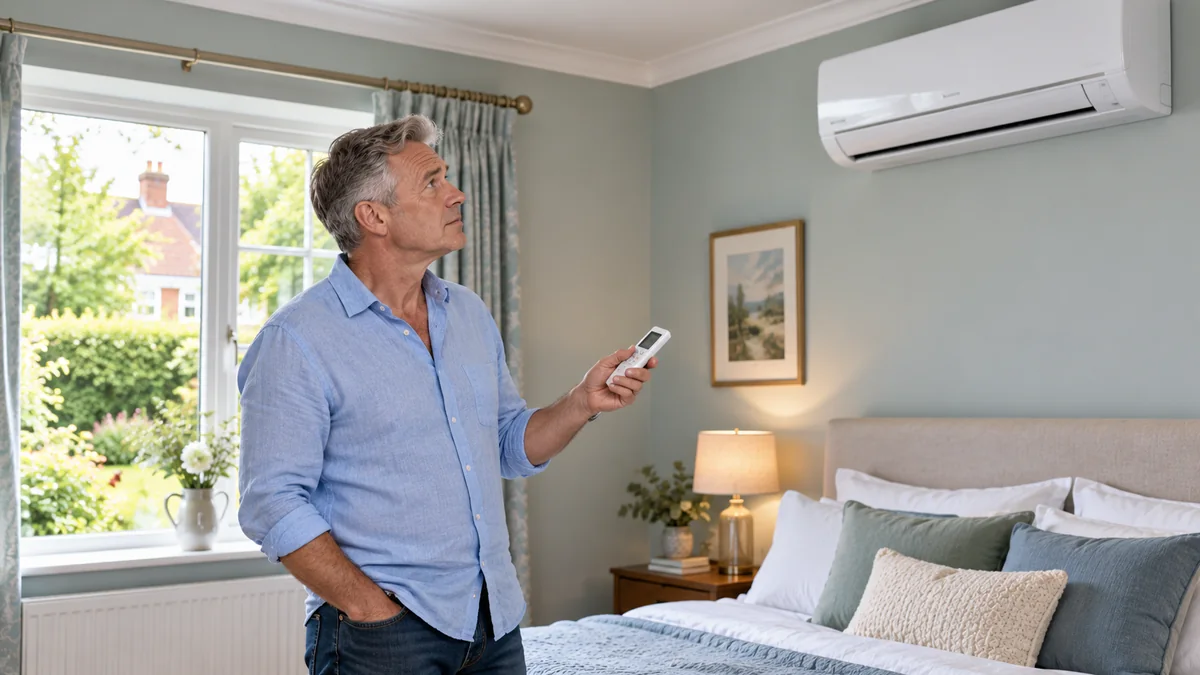
If your air conditioner is running but the room is still warm, first check the settings, filter and airflow. For portable units, make sure the exhaust hose is secure and the window kit is sealed properly. If these steps do not solve the problem, stop troubleshooting and call a professional.
Just because the fan is running does not always mean the compressor is cooling.
What should you check first?
First, check whether the airflow is weak or simply not cool, and look for any error codes.
Set the mode to Cool instead of Fan, Dry or Heat, and pick a temperature lower than the current room temperature. For example, if the room is 28°C, set it to 24°C and wait for the system to respond. Setting it to 16°C will not make most systems cool any faster. If the remote display is blank, check its batteries.
Next, close any open windows and doors and shade sunny windows. Daikin’s UK troubleshooting guide also suggests checking for blocked inlets and outlets. Allow for any start-up delay mentioned in your manual.
Could a dirty filter stop it cooling?
Yes. A dusty filter can block airflow through the indoor unit. You might notice weak airflow, and ice can even form inside. Carrier includes a dirty filter among the possible reasons for weak or warm airflow.
Turn off the unit and remove only the filter your manual says you can take out. Vacuum or wash it as instructed. If you wash it, let it dry completely before putting it back and turning the unit on again. Move any furniture or curtains that might block airflow.
If normal airflow does not return, let an engineer handle any internal cleaning. Our separate maintenance guide covers the routine tasks you can safely do yourself.
For a cleaning schedule and safe DIY checks, see our air-conditioner maintenance guide.
Is the outdoor unit blocked?
If you have a split system, the outdoor unit needs to release the heat taken from your room. Turn off the AC and check for leaves, grass, stored items or plants blocking the openings. Clear any loose debris you can reach safely, and check your manual for the required clearances. There is no universal rule such as “two feet on every side”.
Do not remove the grille or spray electrical parts. Some manuals allow a gentle rinse of the outdoor coil, but only do this if yours explains how. If the outdoor fan is not running while the indoor unit blows air, or if you see damage or heavy dirt, call an installer instead of trying to fix the electrics yourself.
Why is a portable AC running without cooling?
Check that the unit is in cooling mode and that the hose connections are secure. The hot air needs to go outside. Straighten a crushed hose and seal any gaps in the window kit. Meaco’s UK guide also stresses the importance of the hose, window seal and regular filter cleaning.
Clean the accessible filter, following your manual’s instructions. Check for a full-tank warning too: some portable models stop cooling until you drain them, while others handle water differently. Follow your unit’s instructions instead of removing a drain plug at random.
If the unit still only blows room-temperature air after these checks, contact the manufacturer or a repair technician. Do not open the refrigerant circuit.
Should you check the power or circuit breaker?
Yes, check the power if the unit will not start, its display is blank or the outdoor unit of a split system has stopped. Make sure the socket or isolator is on and check the relevant circuit in your consumer unit. For a portable unit, check its plug and socket.
If a breaker has tripped, follow the instructions for your electrical system. Do not keep resetting it to make the AC work. Electrical Safety First advises having repeated RCD trips investigated by a registered electrician. If you notice heat, a burning smell, scorch marks or crackling, turn off the equipment and get help promptly.
What if you see ice or water?
If you see ice on the indoor unit or refrigerant pipe, stop cooling instead of lowering the thermostat further. A dirty filter could be part of the problem, but a technician may need to check the airflow and other causes. Do not scrape off the ice or take apart the casing. Let the unit thaw as your manual describes, and get help if it freezes again.
If water drips from a wall-mounted indoor unit, turn it off and check only the filter you can reach. A blocked drain, pump issue or melting ice could be involved. Do not pour bleach or vinegar into hidden pipes. Call a professional to check it.
When should you call an engineer?
Call an engineer if the system still does not cool after you have checked the mode, filter and airflow. Also call if you see a persistent error code, the outdoor fan does not run when it should, ice keeps forming, water leaks indoors or the system makes strange mechanical noises. Turn the unit off immediately if you smell burning or see water near electrical parts.
Tell the engineer your model, any error codes and which checks you have already made. Refrigerant leaks, control faults and compressor problems need proper diagnosis. In the UK, work on equipment containing F-gas requires the appropriate qualifications.
Could the unit be too small for the room?
Sometimes the AC works, but it cannot keep up with the heat entering the room. Large sunny windows, a loft roof, open doors or an undersized unit can leave the space warm during a heatwave. Try shading the windows and cooling only the area the system is meant to serve.
If your AC has always struggled, ask an installer to check the room’s cooling needs and the system’s capacity. Do not replace it based on floor area alone. If it used to cool well but suddenly does not, investigate a possible fault first.
CostToCool’s free Calculate my current setup tool estimates running costs for an existing unit. The free Plan cooling for my home tool estimates the capacity your rooms might need if you are considering a replacement. Neither calculator can diagnose a broken air conditioner.
Our air-conditioner size guide explains what affects the capacity a room needs.