
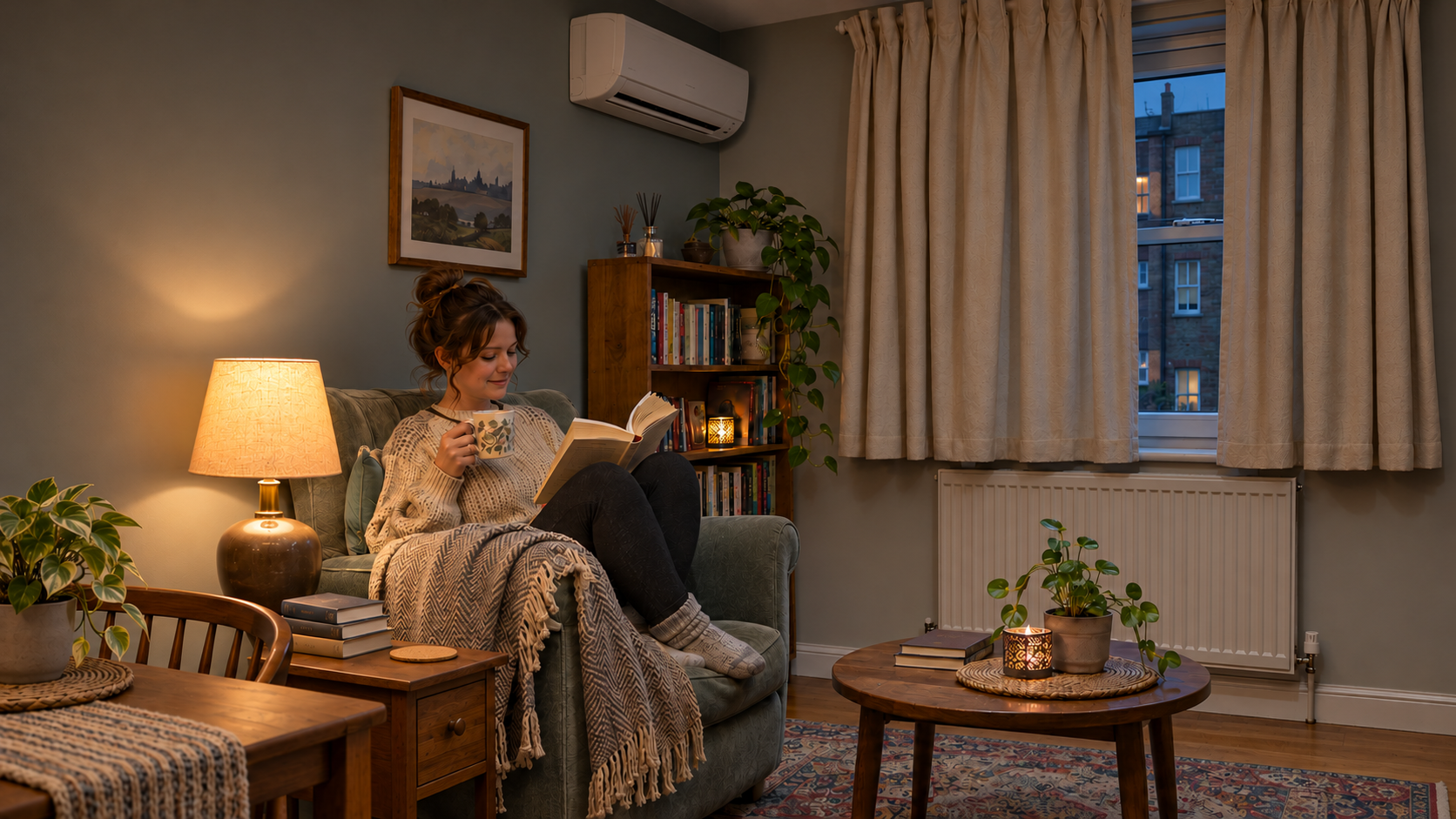
The cheapest way to heat a room usually depends on what you already own. If you have a reversible split air conditioner, it usually uses less electricity than a plug-in heater to provide the same warmth.
With gas central heating, changing the controls might be cheaper than buying a new device. For short periods in a room without heating, a portable electric heater can work, but it costs more per unit of heat.
The best option depends on how long you want the room warm, what heating equipment you have, and whether your central heating also heats other rooms.
Which option is cheapest for your situation?
There isn’t one best choice for every home. Begin by looking at what you already have and how often you need to heat the room.
| Your situation | A sensible first option | What to check |
|---|---|---|
| You have a split AC with heating mode | Heat the occupied room with the AC | Check how well it performs in cold weather. |
| You have gas central heating and use several rooms | Use your heating controls | Avoid overheating rooms you do not need. |
| You need occasional heat in one room | Consider a portable electric heater | Check its power rating and run time. |
| You are sitting still and the room is already comfortably warm | Add a layer or use a blanket | Personal warmth does not replace heating a cold room. |
A new split system costs money to install, even if it’s cheap to run. Also, using central heating for one radiator can still heat pipes and other parts of your home. Make sure to compare the total cost, including any equipment you’d need to buy.
How much does an electric heater cost?
Fan heaters, convectors and oil-filled radiators all turn electricity into heat. No type makes a kilowatt-hour of electricity much cheaper than the others. Your bill depends on how much power the heater uses and how long you run it.
At Ofgem’s October to December 2026 average Great Britain electricity rate of 26.32p per kWh, a 1 kW heater running at full power for four hours costs about £1.05. A 2 kW heater running continuously for the same time costs about £2.11. A thermostat may switch it off for part of that period, so your actual use could be lower. These examples exclude the standing charge, which you already pay whether the heater is on or off.
A portable heater can still make sense for a short spell in one room. Energy Saving Trust notes that it can be useful for occasional extra heat, although standard-rate electricity makes it costly as regular heating. Keep portable heaters away from anything that could catch fire, plug them directly into a socket and follow the Electrical Safety First guidance.
Is a split AC cheaper to run?
If your wall-mounted AC has Heat mode, it works as an air-to-air heat pump. It moves heat indoors rather than producing all its warmth directly from electricity. That usually makes it cheaper to run than a plug-in electric heater for the same heat delivered. Energy Saving Trust explains how these systems work.
For example, if a room needs 2 kW of heat for four hours, a direct electric heater would use 8 kWh and cost about £2.11 at 26.32p per kWh. If a split system gives three units of heat for each unit of electricity, it would use about 2.67 kWh and cost about 70p. This efficiency is just for the example and may not match your model or a cold winter night.
A single indoor unit mostly heats the room it’s in. Its efficiency and heating power can change in colder weather, so check your model’s details before using it as your main winter heating. Our guides Can You Heat Your Home With Air Conditioning? and Does Air Conditioning Use More Electricity in Cold Weather? explain more.
Should you use your gas central heating instead?
Gas is cheaper per kWh than electricity, but boilers and plug-in heaters use energy in different ways. At Ofgem’s October to December 2026 average Great Britain gas rate of 7.97p per kWh, a boiler that’s 90% efficient would cost about 8.86p per kWh of heat. This is similar to the split AC example, but it doesn’t show the cost of running your boiler just for one room.
Your boiler might also heat other radiators and pipes. However, you may have controls that let you reduce heat in other areas. Check your programmer, room thermostat and thermostatic radiator valves; Energy Saving Trust explains how to use them. Don’t change every radiator unless you know how your system works.
If you still use gas for hot water, heating one room with AC will not remove your gas standing charge. If you are weighing the two systems, see our Air Conditioning vs Gas Central Heating guide.
Can you warm yourself instead of the room?
If your room is already comfortably warm, wearing a jumper, using a blanket or using a heated throw can make you more comfortable without turning up the thermostat. This can be a good first step before heating a bigger space. Always follow the product’s safety instructions, especially for electric blankets. Energy Saving Trust also suggests adding layers before turning up the heating.
However, personal warmth is not a substitute for keeping your living space safe and comfortable. NHS advice recommends heating rooms you regularly use to at least 18°C if possible, especially if you are older or have a health condition. Check the temperature where you spend time rather than relying only on how warm you feel under a blanket.
How can you spend less without feeling cold?
Heat the room you’re using to a comfortable level instead of turning the thermostat up high in the hope of warming it faster.
- Close the door to help keep warmth in, but make sure your heater still gets any ventilation it needs.
- Close your curtains at dusk and fix any obvious draughts.
- Make sure radiators, heater vents and AC airflow aren’t blocked by furniture.
- Use a timer or heating schedule that matches when you are actually in the room.
- Check your own electricity and gas rates, since national averages might be different from your tariffs.
If a room loses heat quickly, adding insulation or draught-proofing might save you more money than changing heaters. Don’t let unused rooms get so cold that damp or other problems start.
How do you compare costs in your own home?
First, decide what you want to compare: an hour of extra warmth, every evening in one room, or a whole winter’s use. Then write down the room temperature you want, how many hours you heat it, and the unit rates from your bills. If you’re in Northern Ireland, use your own tariff instead of the Great Britain figures in this guide.
If you have more than one way to heat your room, compare meter readings over a few similar days and keep the room just as comfortable each time. One evening isn’t enough, but a few days can help you see which option works best for your home.
CostToCool’s free calculators only estimate cooling capacity and running costs, not winter heating bills. For heating, use your own tariff, your equipment’s heating details and your meter readings. If you’re thinking about a new fixed system, ask an installer for a room-by-room assessment.