
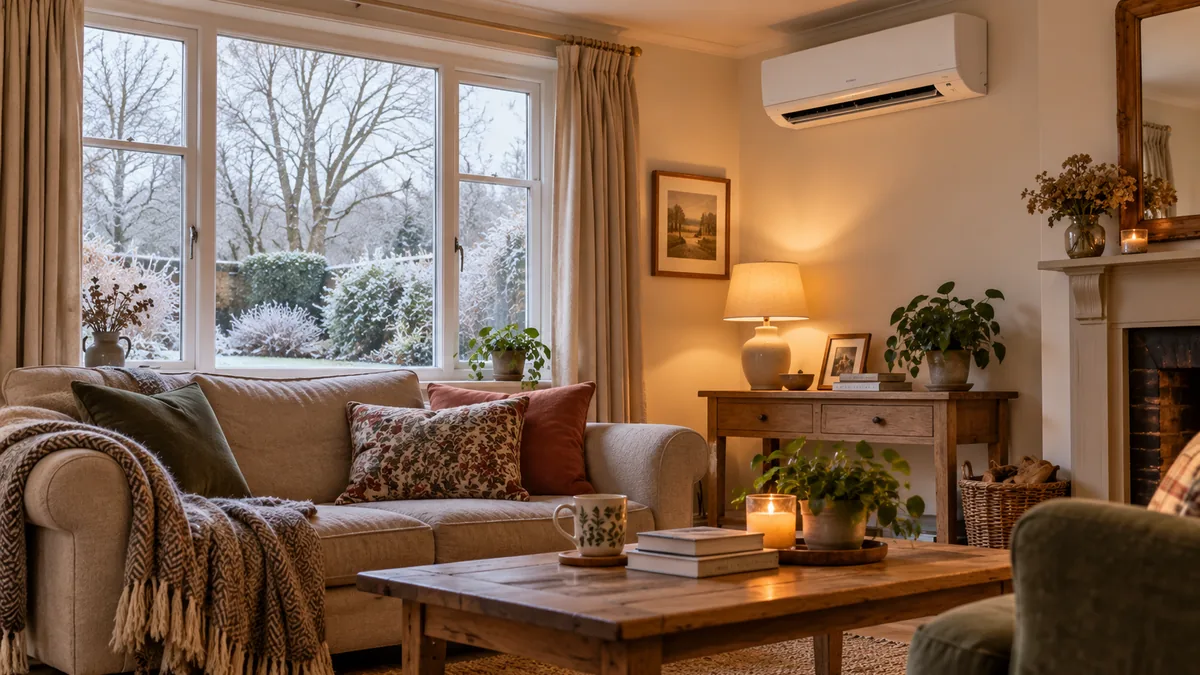
If your air conditioner can heat, try setting it to 20°C in the room you’re using. Give the room time to warm up, then adjust by one degree if you feel too cold or too warm. Many people find 18°C to 21°C comfortable in winter, but every home is different.
What temperature should you set for heating?
Set your living room or home office to 20°C while you’re there. If 19°C feels good, use that. If you’re sitting still and feel chilly, try 21°C. The best setting is the lowest one that keeps everyone comfortable.
The Energy Saving Trust suggests 18–21°C as a comfortable thermostat range. The NHS recommends keeping rooms you use often at a comfortable temperature and, if possible, at least 18°C. This is especially important if you have a health condition. You do not have to settle for 18°C if you still feel cold.
For bedrooms, choose a temperature that helps you sleep well. Check the actual room temperature, especially if the AC is mounted high on the wall. For a baby’s room, follow the NHS advice of about 16–20°C and use a room thermometer.
How do you set an air conditioner to heat?
First, make sure your model can heat. A reversible split air conditioner works as an air-to-air heat pump, moving heat from outside into your room. Some units only cool, so check your manual or model details.
On your remote, choose Heat, usually shown with a sun symbol, and set your preferred temperature. Use an automatic or comfortable fan setting while the room warms up. Keep the air inlet and outlet clear, and direct the airflow across the room instead of towards yourself.
Do not assume Auto mode will heat when you want it to. On some models, Auto can switch between heating and cooling. The US Department of Energy recommends Heat mode during colder months for mini-split heat pumps. Check your manual, as controls vary.
Will setting it higher heat the room faster?
If you set the remote to 28°C when you want 20°C, the system will generally keep heating past 20°C. Raising the target temperature is not a reliable way to warm the room faster.
Some models have a boost or powerful mode that runs harder for a short time. If yours does, check the manual to see how it works and when it returns to normal. Otherwise, set your desired temperature and give the room, furniture and walls time to warm up.
On colder days, it may take longer for the room to reach 20°C. If you keep turning up the temperature, the room could end up too hot. The Energy Saving Trust suggests allowing more time for heating in cold weather instead of raising the thermostat unnecessarily.
Should you leave the heating on overnight?
It depends on whether your AC heats one room occasionally or forms part of your main heating. If you only use it for a few hours in the evening, you might turn it off when the room is empty. See how cold the room gets overnight and whether anyone needs it warm while sleeping.
If you rely on a heat pump for regular winter heating, a setback may be more comfortable than letting the home get very cold and asking the system to warm it again quickly. A setback means choosing a slightly lower temperature while you’re asleep or away. The Energy Saving Trust discusses this approach for heat pumps, although the best schedule depends on your system and home.
Try a small change and see how the room feels in the morning. Keep health needs in mind: the NHS recommends at least 18°C in rooms you use often, including bedrooms, if possible.
Why might 20°C still feel cold?
The number on the remote is a target for the unit’s sensor, not a guarantee that every part of the room is at 20°C. A wall-mounted unit might sense warmer air near the ceiling while the sofa or floor feels cooler. A simple room thermometer where you spend time can help you check.
Draughts, cold windows and poor insulation can also make you feel colder. Before turning up the temperature, check whether warm air can reach you. Close doors to rooms you are not heating, keep furniture clear of the airflow and deal with obvious draughts.
A split unit heats the space it serves. One indoor unit usually cannot heat several closed bedrooms through doorways. If you need to heat your whole home, ask an installer to design a system for all the rooms that need warmth. The Energy Saving Trust explains how air-to-air systems serve different rooms.
Does a lower setting save money?
Usually, a lower target temperature means the system has less heat to supply. However, there is no fixed amount you will save for each degree on a split AC. Electricity use also depends on the outdoor temperature, insulation, system efficiency and how long you heat the room.
Use the lowest setting that keeps you comfortable, and adjust it one degree at a time. Also, make sure you are looking at the electricity your AC uses, not just its heating capacity in kW. These are different figures.
CostToCool’s free Calculate my current setup and Plan cooling for my home tools currently estimate cooling costs, not winter heating costs. To estimate heating costs, use your model’s heating specifications, your electricity rate and the hours you expect to use it.
What if the AC cannot keep the room warm?
First, check that Heat mode is on, the target temperature is set correctly, the filter is clean, and doors or windows are not letting heat escape. In cold, damp weather, the outdoor unit might pause briefly to defrost. Your manual will explain what is normal for your model.
If the room is still cold after the unit has had time to work, do not keep raising the setting and hope for the best. Ask an installer to check whether the system can provide enough heat for that room on a cold day and whether it is working properly.
Tell the installer the outdoor temperature, your setting and the temperature measured where you sit. That gives them a better starting point than simply saying, “The remote says 20°C.”