
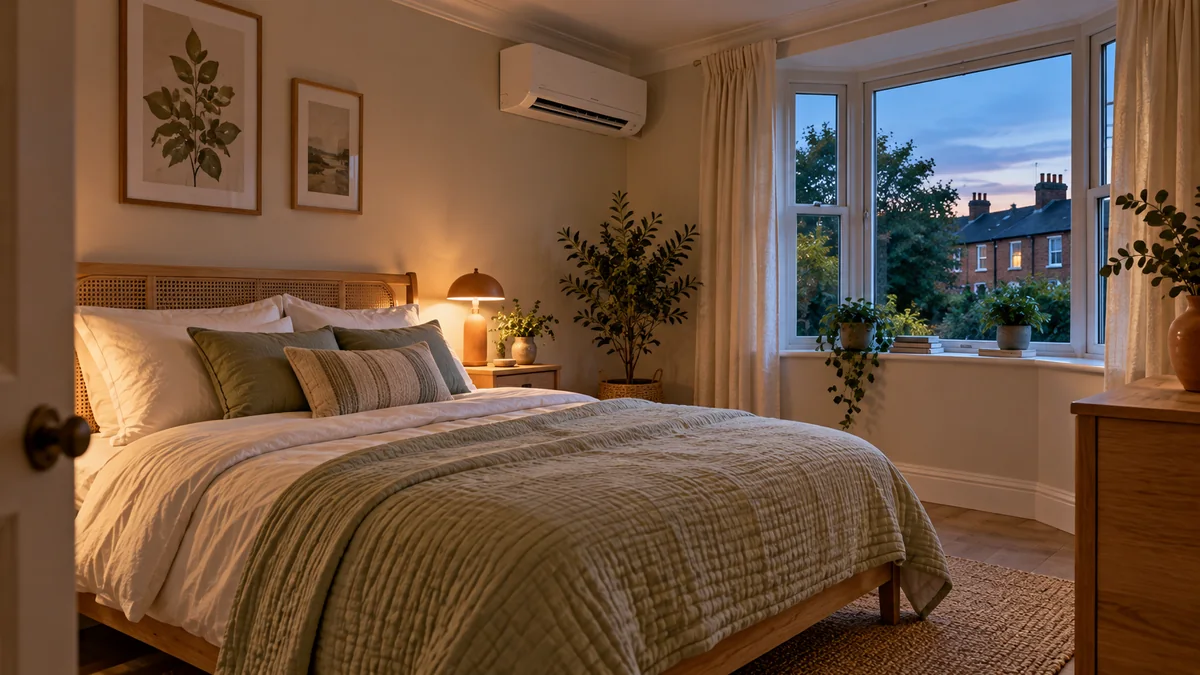
If your bedroom stays warm at night, air conditioning can help you sleep better. Smaller bedrooms usually need less cooling than living rooms, but choosing the right unit is about more than just size. Roof insulation, afternoon sunlight, and how noisy the unit is near your bed are just as important as the room’s measurements.
What size air conditioner does a bedroom need?
Measure the floor area of your room and use a general range to start. The table is based on average insulation and a standard ceiling height.
| Bedroom floor area | Rough cooling capacity | Approximately, in BTU/h |
|---|---|---|
| Up to 15 m² | 1.5–2.0 kW | 5,000–7,000 BTU/h |
| 15–25 m² | 2.0–3.5 kW | 7,000–12,000 BTU/h |
A ground-floor bedroom that stays shaded will likely need less cooling. In contrast, a loft bedroom with poor roof insulation and a west-facing window may need more cooling, even if both rooms are the same size.
The kW and BTU/h numbers show how much cooling the unit can provide, not how much electricity it uses. For example, a unit with 2.5 kW of cooling usually does not use 2.5 kW of electricity. Before buying a fixed unit, ask an installer to look at your bedroom and suggest the right size.
Our room-size guide explains the wider sizing factors and BTU/h conversions.
How much does bedroom AC cost overnight?
The cost to run your AC depends on how much electricity it uses at night. To estimate, multiply the unit’s average power use in kW by the number of hours you run it and your electricity rate per kWh. An inverter split model may use more power at first, then less once the room is cool.
The following examples use a rounded rate of 26p per kWh. For reference, Ofgem’s average for Great Britain is 26.32p per kWh for October to December 2026 on a standard variable tariff paid by Direct Debit. Your actual costs may be higher or lower depending on your model and bedroom.
| Average electricity use while cooling | Eight hours | Eight hours for 30 nights |
|---|---|---|
| 0.4 kW | £0.83 | £25 |
| 0.7 kW | £1.46 | £44 |
| 1.0 kW | £2.08 | £62 |
The table does not include standing charges, purchase price, or installation costs. Check your own electricity tariff. Northern Ireland has a separate electricity market, and its Consumer Council lists local tariffs. Rates in Great Britain also vary by region and payment method.
Is a split or portable unit better for a bedroom?
A wall-mounted split system puts the compressor outside, so the indoor unit can often run more quietly at a lower setting once the bedroom is cool. It costs more to buy and install, and you will need a good spot for the outdoor unit.
A portable unit might work well in a rented home or for occasional hot nights. Its compressor runs inside the bedroom, and the exhaust hose needs a window kit that seals well. It can be noisier near the bed. Neither type is always quiet, so compare the indoor noise levels for the models you are considering, especially at the setting you would use at night.
The UK air-conditioner energy label includes information about indoor sound power. Some product listings show sound pressure instead. Ask for noise figures that are measured in the same way, ideally at the fan speed you plan to use at night.
For a closer look at sound figures and sleep, see our portable-versus-split noise guide.
What temperature should you use at night?
Try 23–24°C before bed, then see whether 24–25°C, sleep mode or a timer keeps you comfortable overnight. These are starting points, not health rules. If someone in the household is especially vulnerable to heat, focus on whether their sleeping space stays safely comfortable rather than following a fixed number.
Sleep mode can alter the temperature, fan speed or both. Check your model’s manual. A timer may save electricity, but a hot loft can warm up again quickly.
Setting the thermostat much lower than your target temperature usually will not cool the room any faster. It may just make the AC run longer. Pick a temperature that feels comfortable and adjust it by one degree at a time if needed.
Where should the unit and airflow go?
Direct the cool air across the room instead of at your face or bed. Even if the temperature feels right, a steady cold draught can interrupt your sleep. Talk with your installer about the position of the bed, windows, and indoor and outdoor units.
If you use a portable unit, put it near a suitable window and avoid stretching or bending the exhaust hose. Clean the filter as the manufacturer suggests, and make sure the window kit seals any gaps around it.
Most air conditioners recirculate the air already inside your room. When you turn the system off and it is cooler outside, ventilate by opening windows if it is safe to do so. The Energy Saving Trust points out that air-to-air systems do not bring in fresh air.
How can you keep the bedroom cooler before bed?
Close curtains or blinds before sunlight hits your bedroom windows. If it is hotter outside than inside, keep the windows closed. Later, if the air outside cools down and it is safe, open the windows. The NHS recommends checking rooms where people at higher risk sleep and opening windows after outdoor temperatures drop. If you are using AC, close the windows again.
Switch off electronics you do not need and use lighter bedding. If another room is cooler, it might be easier to sleep there for a few nights instead of trying to cool a hot loft bedroom. Better shading or roof insulation can help too.
Plan the cooling and cost for your bedroom
Begin by looking at your bedroom’s floor area, ceiling height, insulation, and windows. Also, pay attention to when the room gets too warm, how long you plan to run the AC, and how much noise you can tolerate.
If you already have an air conditioner, CostToCool’s free Calculate my current setup tool can estimate running costs for your room and night-time use. If you have not bought one yet, the free Plan cooling for my home tool can suggest a capacity range and estimate running costs for a recommended setup. Both tools give estimates, so an installer should confirm the size and placement of a fixed system.